Trees
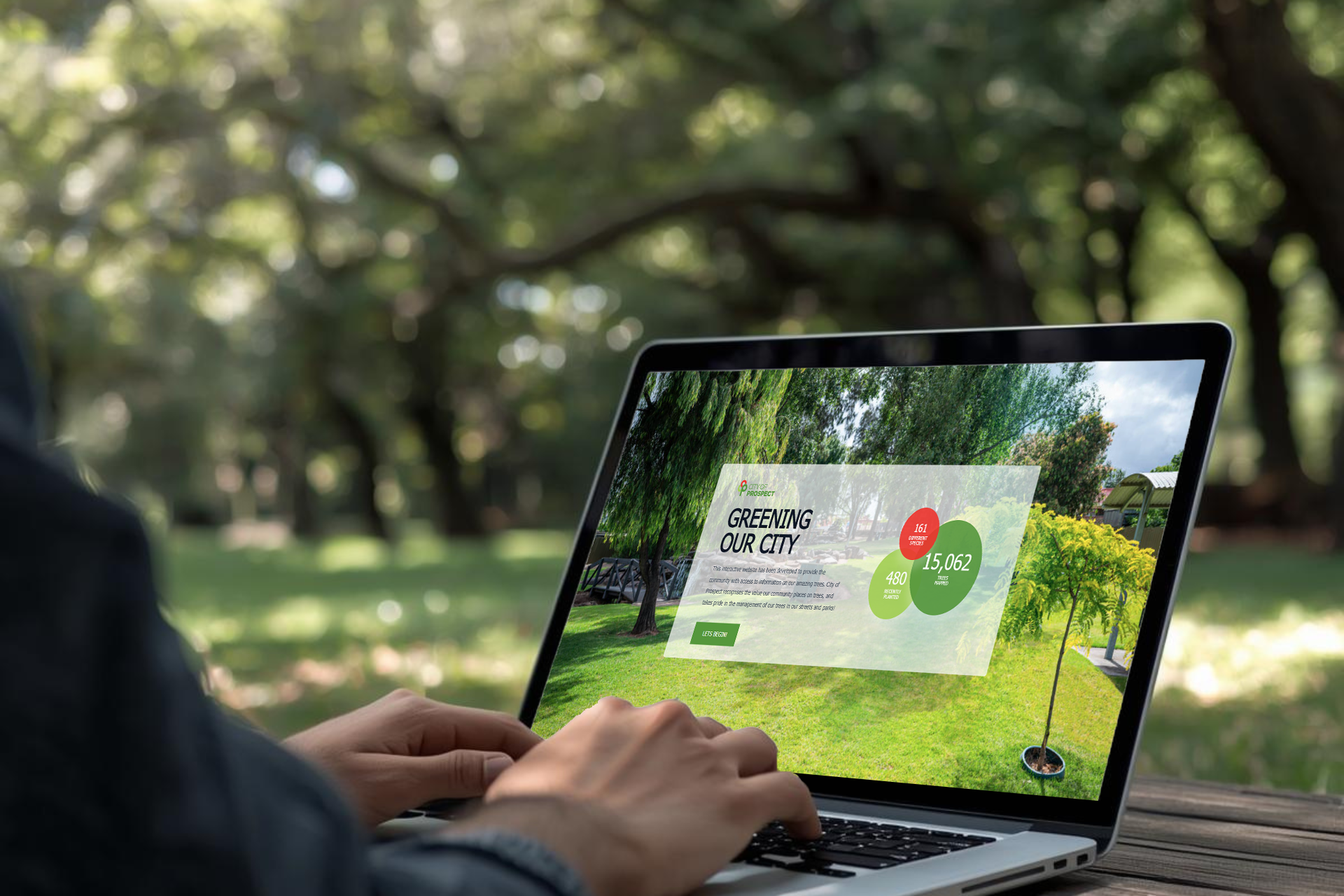
Ever wanted to know more about the street trees in your neighbourhood? Check out our new Interactive Urban Forest map.
Why explore our map?
- Identify your trees - Zoom into your street or local park to find out the species, age and size of any street tree
- Stay updated - See exactly when your street tree was last watered or pruned, and track where new trees are being planted near you
- See our progress - Explore our city's biodiversity and see our future planting plans for a greener, cooler community.
Street trees provide enormous benefits to the community including physical, visual, environmental, social, and economical.
We manage over 15,000 street trees across City of Prospect, which requires a proactive approach to maintenance. We program our maintenance of these trees based on:
- age
- condition assessments
- new developments
- storm damage
- customer requests.
Street tree planting program
We get lots of resident requests for planting new street trees. We assess each request on an individual basis, and all planting is subject to space, underground services, suitability of location, tree species and budget. Tree planting typically occurs between June and October each year, which is the best time to establish a healthy root system.
Requesting tree maintenance
Trees offer so many benefits; however, we know it takes some maintenance to keep them beautiful.
You can submit a report about a tree on Council property via our Request a Service page.
We will investigate requests for tree issues on Council land. Requests may include:
- tree trimming and pruning
- suspicious damage
- tree removal
- tree plantings
- storm damage and debris on bike paths
- Council tree branches fallen on private property.
We will not:
- remove healthy and stable trees
- remove or prune trees to improve your view
- remove or prune trees shading solar panels or your garden
- remove or prune trees to reduce leaf fall, fruit fall or bird droppings
- clean out gutters or prune for debris in gutters
- remove leaves from street trees on private property
- investigate trees on private property.
If there is an imminent danger or hazard, please call our Customer Service team on 8269 5355 at any time of the day or night.
Tree removals
Council recognises the important environmental, habitat and community value of trees and will always seek to retain them where possible.
Tree removal is considered a last resort, with alternative options such as pruning or other management measures investigated first. Removal may be supported where a tree is dying, affected by disease or pests, poses an unacceptable risk, or is no longer suitable for its location.
Frequently asked questions about tree removal
There might be dead trees found across our region for several reasons.
A habitat tree
It may not seem like it, but large dead trees still provide many important benefits, like habitat for wildlife (i.e. hollows) and soil stabilisation. We retain trees where possible, and continue to assess them for structural integrity and safety.
Community Connection
A tree may hold community, cultural or historical value.
Ongoing investigation of tree vandalism
It is an offence for a person to cut, saw, poison or remove any tree or shrub on public land. Unfortunately, tree vandalism sometimes occurs, and dead or dying trees will remain while investigation and prosecution is undertaken.
Unreported tree
We manage thousands of trees, and though they are audited regularly, it can be sometimes be a little while before we notice a tree has died. You can bring a tree to our attention by contacting us on .
It’s on our list!
If the tree does not pose any immediate harm or risk, its removal may be scheduled on our list of things to get to. You can always touch base with the local council to check the status of a particular tree.
We have hundreds of thousands of trees we actively manage and maintain, and are working to increase this number every year.
We always aim to keep trees where possible, however just like any other asset, sometimes trees need to be removed if they pose a risk, are dying, infected by disease or pests, or are no longer suitable for their location.
Managing trees and infrastructure is a delicate balance and one that doesn’t always work together. Alternative actions are investigated and taken before removal is considered. Tree removal is always the last option.
If a tree is on private land then it can be removed at the discretion of the landowner, unless it is a Significant or Regulated Tree in which case it sits under state legislation.
We generally don't plant trees that are known to be highly allergenic.
We recognise that windborne pollen from grass, weeds and trees can trigger asthma and other allergies for some individuals.
We won't remove trees for this purpose, as allergens are usually seasonal and can travel long distances making it is difficult to pinpoint where exactly the allergen originated.
We recognise trees provide some risk, however the benefits that large trees provide to the community are immense.
Trees in our region are monitored regularly by councils and include maintenance programs to ensure any associated risks are reduced or removed. Depending on the location, some trees are monitored more often than others, for example, trees near playgrounds or picnic tables where people visit frequently.
Sometimes we hear from residents that Gum trees drop branches more frequently compared to other trees. Gum trees are the most dominant/common tree in Australia, and therefore, a larger overall number of branches are dropped from gums.
Evidence shows that there is a low mortality rate caused by tree failure or dropping branches, and in Australia, about 1 in every 5 million people loses a life from this (Hartley & Chalk, 2019). Approximately six times more people are killed each year falling from ladders.
If you are concerned about a tree, please report it to council so they can send a qualified arborist to inspect and determine if any works are required. Removal will only be considered as a last resort.
Trees provide many benefits for the entire community so we don't like to remove a healthy, sound tree due to nuisance or dislike.
To request the removal of a council tree, you can submit a request stating the reasons for removal and any documentation supporting this.
Please be aware that as per council strategies and policies, removal for the following reasons will not be supported:
- Removal or pruning of trees to improve or create views.
- Removal or pruning of trees that are shading lawns or gardens, or inhibiting growth.
- Removal of trees for driveway crossings where other options are available.
- Removal or pruning of trees to reduce fruit fall, leaf fall, sap drop, bird droppings or similar.
- Removal or pruning of trees to improve sight lines to signage on buildings.
- Removal or pruning to increase street lighting onto private property.
Members of the public are not permitted to remove, damage or prune trees on council land.
If removal is supported, a Section 221 permit is required and applicable fees will apply, including the cost of tree replacement. Unauthorised removal of a tree on Council land is prohibited and may result in penalties.
To request a tree or stump removal, contact our City Works and Presentation team at 8269 5355 or email admin@prospect.sa.gov.au.
For more information, download a copy of our Tree Removal Guidelines.
Tree watering
We have a Tree Watering Program to water newly planted trees for three consecutive years during the summer months and hot/dry periods of each year. Watering generally begins in October of each year, and continues through until March, depending on the hot/dry weather each year. Tree watering for the first three years is to ensure that the young trees have the best chance to establish themselves and a healthy deep-root system.
We encourage residents to support our watering program by providing street trees with a bucket or two of additional water during the drier months of the year on a regular basis. Keeping grass and other plants away from the planting holes will also further assist in the trees’ establishment.
See exactly when your street tree was last watered via our Interactive Urban Forest map.
Street trees and powerlines
Ensuring we have a safe and reliable supply of electricity is of paramount importance to SA Power Networks. To achieve this, vegetation needs to be trimmed around powerlines to minimise the risk of outages, avoid damage to lines and ensure public and community safety.
Pruning works are carried out by a qualified horticulture team to ensure pruning is kept to a minimum where possible. Further information is available from SA Power Networks on 13 12 61 or at sapowernetworks.com.au.
Contact us
For more information on street trees in our city, you can contact our City Works and Presentation team on 8269 5355 or email admin@prospect.sa.gov.au.
Frequently Asked Questions
For any new tree requests, we encourage you to put something in writing. You can do so through the Contact Us page. This is often the quickest and most direct way to submit your request.
Alternatively, you can contact us on 8269 5355.
We are still in the process of developing the Urban Street Tree Guide which determines species for each street. Currently, we utilise our 21st Century Street Tree Manual.
The Manual specifies which species of tree will be planted in each street in order to retain uniformity to enhance the visual streetscape appeal. As the manual develops into the Urban Street Tree Guide, species will be reviewed to ensure that only those that will eventually green tunnel are specified.
This issue can also be raised as a Request - click here. Each customer request received for street tree maintenance is inspected and assessed, taking into account the following aspects:
- Tree species
- Tree size – to determine if significant or not
- Overall health/condition
- Structure and defects present
- Proximity to infrastructure and dwellings
- Risk to the community
From this initial inspection, appropriate actions are recommended, enabling Council to effectively maintain the tree and manage public risk, based on its condition and potential for hazard. If the tree is determined to be high risk, appropriate remedial works will be carried out as soon as possible.
For trees that pose a low risk, maintenance works will be addressed as part of the ongoing street tree maintenance program.
Residents are not permitted to prune street trees as it is Council's responsibility to ensure that pruning works are undertaken by trained personnel and in accordance with Australian Standards for tree pruning and occupational health and safety.
Generally, trees will be allowed to develop their natural canopy and will not be pruned. Where pruning is essential, it will be carried out in accordance with Australian Standards, for the express purposes of:
- Providing clearance for pedestrian movement
- Improving the safety, structure and health of the tree
- Maintaining clearances for utility services such as powerlines
- Improving vehicle driver's line of sight along vehicle carriageways
- Preventing branches encroaching into neighbouring property from public property
We undertake formative pruning during the early stages of the tree’s life to ensure that the tree takes good shape and form.
Once the tree reaches maturity, we undertake block pruning as required to ensure footpath and road clearances are maintained.
Any trees with branches within high voltage power lines can only be pruned and trimmed by SA Power Networks (SAPN) and their approved contractors.
Any concerns you may have around this should be raised directly with SAPN immediately. They can be contacted on their Faults and Emergencies line 13 13 66.
SAPN undertake line clearance pruning every two years in order to minimise any issues and hazards.
Green Tunnel Project
Attractive tree-lined streets with beautiful leafy green canopies are a unique feature of Prospect.
Our iconic Green Tunnels, streets lined with trees where their canopies grow to touch across the street, are fundamental to creating a sense of place and increasing health and wellbeing across City of Prospect.
Increasing tree canopy cover through planting Green Tunnels will address the impacts of the challenges presented in this strategy through increasing biodiversity, cleaning the air and capturing carbon dioxide, reducing the heat island effect, protecting infrastructure assets, managing stormwater, providing shade, improving health and wellbeing, and cooling our city.
Using the Heat Maps developed through Council’s Urban Heat and Tree Canopy Mapping Project in collaboration with Resilient East , Council is prioritising areas of public land for planting, to create ‘green tunnels’ and a cooler, liveable City. By identifying urban heat spots, we take on a proactive approach to tree planting and increase local resilience.
Trees are a long-term investment, and it can take between 10 to 30 years to experience the benefits of today’s actions. Selected species will be chosen based on their ability to form a ‘green tunnel’, with canopies eventually touching across a street overtime. By planting larger trees, we can also achieve a ‘green tunnel’ effect faster.
Find out more
If you would like any more information on our Green Tunnel Project, please contact us on 8269 5355 or email admin@prospect.sa.gov.au.
Urban Heat and Tree Canopy Mapping
Understanding the extent of tree canopy, green spaces, permeability, building footprints and urban heat across our city helps us plan for a cooler city.
In support of our Green Tunnels and tree canopy targets, we have partnered with the State Government, Resilient East and 18 local government areas across metropolitan Adelaide to map tree canopy, green spaces, built environment, and urban heat. The project involved reprocessing the earlier data captured in 2018 and 2019 to be as comparable as possible with the 2022 data.
With this new data capture, there is now, for the first time, a contiguous dataset across the entire metropolitan Adelaide region that will allow detection of changes in tree canopy extents, green spaces, impermeable surfaces, and building footprints over time.
The data captured in this project will be used by us to identify areas where there are changes in tree canopy, to plan future planting or urban heat mitigation projects, assess the success of previous initiatives, measure against current targets and inform future objectives.
Key Highlights:
- Tree canopy covers about 16.5% of City of Prospect, or approximately 7,806,727 square metres
- 17% of metropolitan Adelaide is covered in tree canopy
- Impermeable surfaces, like roads, buildings and other hard surfaces, cover 29% of metropolitan Adelaide
- Permeable surfaces, like bare earth, grassed areas and vegetation make up 67% (about 3.5% of the study area was water).
Keen to explore the new high-resolution surface temperature data and tree canopy cover for City of Prospect? Want to find the technical reports? Enter your address to see how cool or hot your property is, and how it relates to nearby trees at Urban Heat and Tree Mapping of Adelaide Metropolitan Area
Find out more
If you would like any more information on the Urban Heat and Tree Mapping Project, please contact us on 8269 5355 or email admin@prospect.sa.gov.au.
Contact us
For more information about trees in our city, please call 8269 5355 and ask for our City Works and Presentation team, or email admin@prospect.sa.gov.au.