
Bees
Bees play a vital part in the pollinating of our veggie patches as well as our native plants and gardens. Around 80% of the food we eat relies on pollination for growing and farming.
Keeping Bees
In South Australia, any person who keeps honeybees must register as a beekeeper with Primary Industries and Resources SA (PIRSA) every 12 months.
You must register regardless of the:
- number of hives
- purpose for keeping honeybees (i.e. you must register even if only keeping one hive in the backyard for interest)
- type of hives (including: observation hives, nucleus hives, Top bar hives, Warre hives, and Flow hives).
For more information visit: https://pir.sa.gov.au/biosecurity/animal_health/bees/beekeeper_registration
Residents in City of Prospect may keep bees so long as they prevent them from being a nuisance to neighbours or other members of the community. For this reason, Council recommends residents who wish to keep bees on their property for non-commercial purposes to first consult with PIRSA and comply with any requirements they may have for the safe keeping of bees.
It is recommended that the number of hives is kept to a minimum, only one or two at the most and hives should be positioned away from neighbouring properties or local government land, for example:
The recommendation is that bees should not be kept in those parts of the area which are within 50 metres of:
- Any building in the occupation of another person
- Any street, road or public place
- On any street, road or public place under the control of the Council.
The keeping of bees in any parts of the area should not result in a nuisance or danger to persons therein.
To prevent the keeping of bees in places where they may be a nuisance or danger to persons, and for the comfort and safety of the inhabitants of the area, the Local Nuisance and Litter Control Act 2016, provides Council with the responsibility to investigate and manage Local Nuisances.
For additional information see A Guide to Bee Keeping.
Bee swarms
Bees are the superheroes of our gardens, parks and farms. They pollinate the flowers and plants that we love, and they help us grow most of the food we eat, so it’s a sign of a healthy environment to see a few bees buzzing about. Bees also provide us with wax and delicious honey.
During the warmer weather, bees may form a colony outside of the hive. This is called swarming. It means that the bees are trying to get cool or establish a colony.
If you spot a swarm, don’t panic! It means they’re looking for a bigger, better treehouse and are temporarily protecting their Queen. These swarms are typically non-aggressive, but we ask everyone to please keep a respectful distance and admire the busy works from afar.
For some people, the size of a swarm can be concerning. Generally during this state, the bee colony is not aggressive as they are trying to protect the queen.
If you have a known bee allergy, please keep well away from the signed areas.
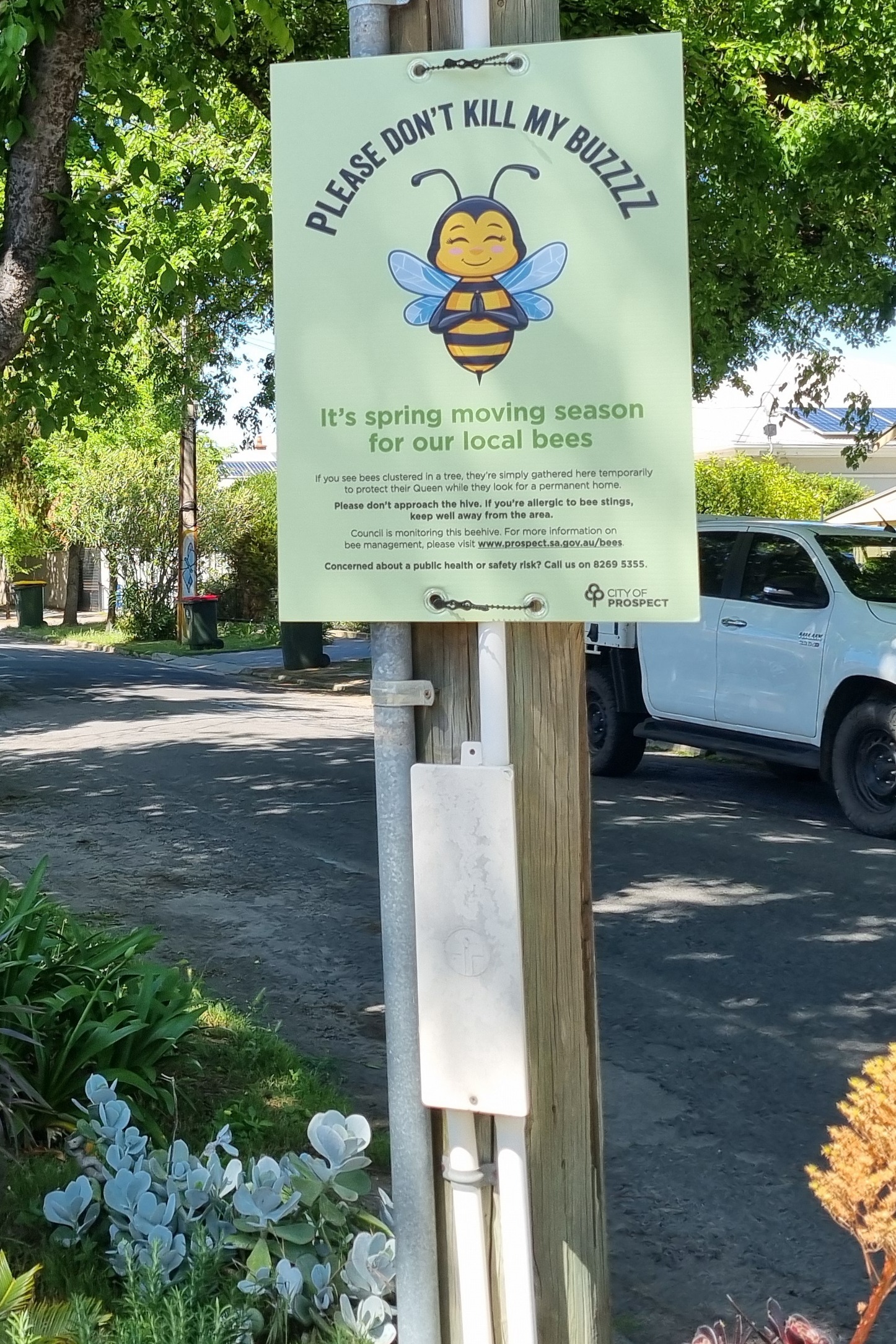
On Council Property
Remember, bees are important for our environment and food production. Every attempt will be made to allow the bees to remain or to relocate the bees without destroying them. However, at times, access may be difficult, and destruction may be the only option.
When you first see a swarm of bees they may just be passing through, so we ask that you wait at least 48 hours before contacting us. The exception is if the swarm is in a hazardous location where people are in danger, in which case please contact us immediately.
Please note however, if the bees are swarming but have not settled into a hive for at least 48 hours, we cannot arrange for their removal. Often the queen bee settles for 24-48 hours, and a temporary hive is formed to protect her.
Bees that have formed a hives over 2 metres high in a tree will not be removed as generally this does not pose a health or safety risk.
To report a bee swarm or hive that is causing a nuisance or public safety risk, please call our Customer Service team on 8269 5355.
Council will attend, install signage to alert the public to the presence of the bees, and undertake an assessment to determine if additional action is required.
We will continue to monitor the swarms, however if you believe there’s a genuine public health or safety risk, please call us on 8269 5355. We’ll then contact a professional apiarist (beekeeper) to assess and consider relocation.
On Private Property
Council does not provide a service to relocate bees from private property. It is the resident’s responsibility to arrange an apiarist or pest controller to remove the bees from their property, at the resident’s cost.
Warning – do not disturb or attempt to remove a bee colony yourself. An authorised contractor should be engaged for the removal/destruction of the bees.
Since it is a specialised task, we do not recommend attempting to remove a bee colony yourself.
If you need help, there are many organisations specialising in bee relocation. For additional information, a list of Do’s and Don’t and contact details for Apiarist’s, please visit bees.org.au/swarms.
Wasps
There are many types of native wasps which are an essential part of our ecosystem with two of the more common wasps being the Mud Wasp and the Paper Wasp. We do not provide a mud wasp or paper wasp removal service.
Paper Wasps
Paper wasps are native to Australia and are common in Adelaide. They can be identified by the characteristic papery nests they construct. The nest consists of a single layer of exposed hexagonal cells which look like part of a honeycomb, attached by a small but strong stalk to the branch of a tree or shrub or under the eaves of a building. The nests usually grow to 10cm in diameter but will occasionally reach 15cm.
The wasps are slightly longer and thinner than honey bees. They have very narrow waists and can be dark or light brown, orange or gold with one or two narrow black bands on their bodies.
Paper wasps are a very beneficial insect to have in the garden as they capture many pest insects, including caterpillars, to provision their nest.
The wasps are unlikely to sting unless their nests are disturbed. When they are away from their nest the wasps are not aggressive. If the nest is left alone the wasps will not attack. A nest may only need to be destroyed if it is very close to where people walk or stand.
Council does not provide a service to residents for the destruction of Paper Wasp nests.
Mud Wasps
A number of native wasp species build mud nests which they often attach to walls, rafters and under eaves. A mud nest consists of cells each packed with paralyzed prey (usually caterpillars or spiders) together with a wasp egg. The hatching wasp maggot consumes the stored prey sealed in the nest. After changing into an adult wasp, it breaks out of the nest.
The wasps range in size from small to large, and are black and orange, or plain black. Mud wasps can safely be ignored, as none of them are aggressive towards people. If necessary, a nest can be simply scraped off.
European Wasps
If you see European Wasps this indicates that there is a nest or two close by. The only way to get rid of European wasps is to find and treat the actual nest, usually identifiable by a steady stream of wasps coming and going.
Council will identify and destroy European wasps nests reported by members of the public.
If you are unsure of the wasp type, you can submit a photo with your request. Residents will need to pay for the call out if it is for any other type of wasp.
Contact us
For more information about keeping birds, please call 8269 5355 and ask for our Community Standards team, or email admin@prospect.sa.gov.au.